
The Nevada Current is widely characterized as leaning left or progressive. It is an affiliate of States Newsroom, a large nonprofit news network that originated from progressive advocacy roots and receives funding from left-leaning donors and foundations.
Funding and Background
- Parent Organization: The Nevada Current is part of States Newsroom, which originally launched as an incubator project under the liberal Hopewell Fund (managed by Arabella Advisors) before becoming an independent 501(c)(3) nonprofit.
- Donors: While the network publishes its donor lists, its financial backing includes progressive grant-makers and philanthropic organizations that often support left-of-center policy initiatives.
Content and Editorial Stance
- Reporting vs. Opinion: The publication states that it maintains editorial independence, and media watchdogs note that its straight news reporting often adheres to standard journalistic practices.
- Commentary: Its opinion and commentary pieces generally reflect a progressive or left-leaning perspective on state politics, labor, environment, and public policy issues.
This is the context you need to have to understand the story published recently on the Nevada Current website titled, “With 2nd approval of Question 6, voters can secure abortion rights in state constitution”.
It is accurate when it says, “Question 6 would establish abortion as a fundamental right in the state constitution … “
Think about that. Abortion as a fundamental right. How is it possible that the citizens of Nevada would consider that abortion is a “fundamental right”?
Abortion is now a states right issue. The overturning of Roe v. Wade with the US Supreme Court’s ruling in Dobbs. The Dobbs v. Jackson Women’s Health Organization decision is a landmark June 24, 2022, U.S. Supreme Court ruling. The 6–3 ruling concluded that the U.S. Constitution does not confer a right to an abortion. It officially overturned Roe v. Wade (1973) and Planned Parenthood v. Casey (1992), returning the power to regulate or ban abortion to individual states.
In our opinion, it’s time for the citizens of Nevada to wise up. More than $14 million has been poured into supporting Nevada Question 6 (known officially as the Right to Abortion Initiative) across its two consecutive election cycles. [1, 2]
Because constitutional amendments in Nevada require voter approval in two consecutive general elections to take effect, fundraising has spanned across both the 2024 and 2026 campaigns:
- 2024 Election Cycle: The primary political action committee (PAC) backing the amendment, Nevadans for Reproductive Freedom, raised $13,201,142.51. The measure passed its first hurdle with 64.4% of the vote in 2024.
- 2026 Election Cycle: As the measure returns to the ballot for its second and final mandatory approval vote, the supporting campaign has raised an additional $815,911.55, bringing the funding raised to push this measure over the finish line to a little over $14 million.
- If passed, the measure would allow, essentially, abortion on demand through all nine months of a pregnancy.
- The language: “All individuals shall have a fundamental right to abortion performed or administered by a qualified health care practitioner until fetal viability, or when needed to protect the life or health of the pregnant patient, without interference from the state …”
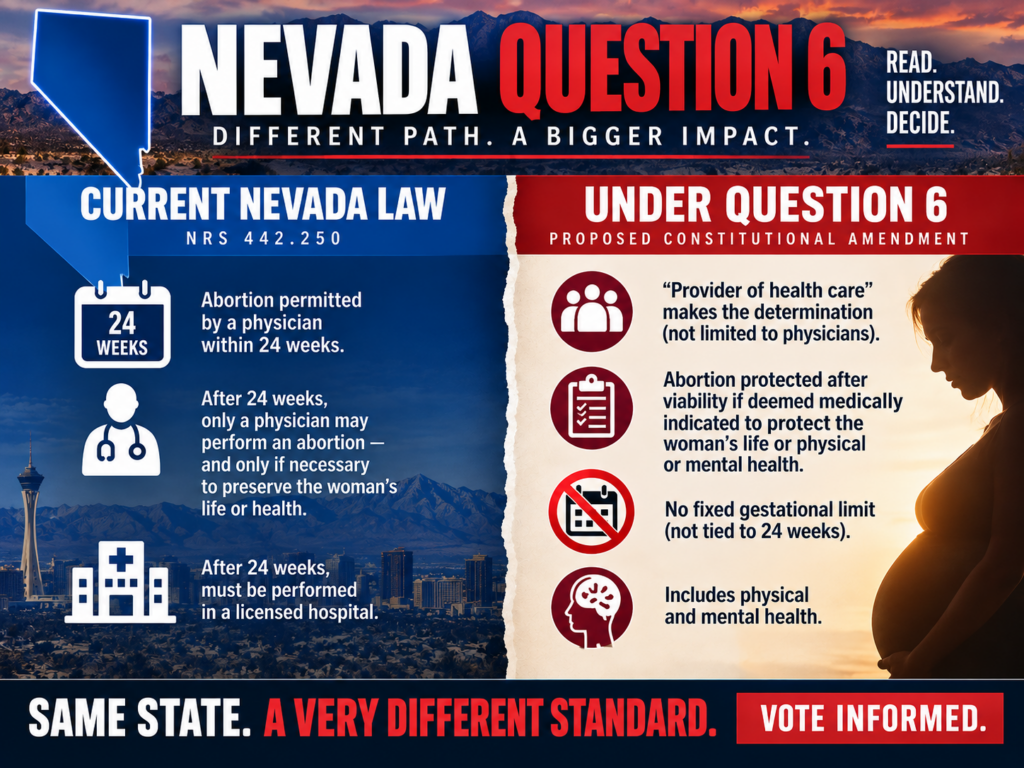
- What that means: The key is that “until fetal viability” is not a fixed number of weeks written into Question 6. The amendment uses a “health care” standard instead. A “a qualified health care practitioner” does NOT mean a doctor. It can mean anyone in the health care profession, defined by who knows who?
Question 6: Read the Fine Print on Abortion After Viability
Nevada voters should read the actual language of Question 6—not just the campaign slogans surrounding it.
At first glance, the proposal sounds straightforward if you don’t really think about it all that much: establish a constitutional right to abortion until fetal viability.
First: A constitutional RIGHT TO ABORTION without establishing specific and solid parameters around what happens after week 24, the demarcation line, legally, for “viability” of the fetus — the baby. But the language governing what happens after viability deserves considerably more scrutiny.
Nevada’s current law provides a useful point of comparison. Under NRS 442.250, an abortion may be performed by a physician within the first 24 weeks of pregnancy. After the 24th week, an abortion is permitted only when the physician has reasonable cause to believe it is necessary to preserve the pregnant woman’s life or health. The statute also requires abortions after 24 weeks to be performed in a licensed hospital.
Nevada’s regulations define weeks 13 through 24 as the second trimester and begin the third trimester at week 25.
Question 6 takes a different approach.
It does not establish a 24-week constitutional cutoff. Instead, it defines fetal viability according to the professional judgment of an “attending provider of health care.” This is important: THAT DOES NOT MEAN A PHYSICIAN/MEDICAL DOCTOR.
Then comes the provision that should concern anyone who believes there ought to be meaningful limits on abortion after viability.
After viability, Question 6 says the state may regulate abortion, but “in no circumstance” may it prohibit an abortion that an “attending provider of health care” determines is medically indicated to protect the pregnant individual’s “life or physical or mental health.” Who is that, exactly? And how does one define “life or physical or mental health”?
Now consider who gets to make that determination.
The amendment does not say “physician.” It does not say “medical doctor.” It does not say “obstetrician.” Instead, it uses the much broader term “provider of health care.”
That is not merely a semantic distinction. Nevada law defines “provider of health care” broadly, encompassing numerous licensed health-care professions beyond physicians – including, even, licensed dieticians. The constitutional amendment itself does not impose a physician-only requirement for the professional judgment concerning viability or the post-viability health determination.
Nor does the amendment restrict the post-viability exception to situations in which the mother’s life is in immediate danger. It specifically includes physical or mental health.
And unlike current Nevada law, which establishes a clear 24-week statutory threshold, Question 6 does not establish a final constitutional week—28 weeks, 32 weeks, 36 weeks, or otherwise—after which its post-viability protection simply disappears.
That difference is significant.
Under current law, the statute specifically says physician and specifically establishes 24 weeks as the general limit. After that point, the physician must have reasonable cause to believe the abortion is necessary to preserve the patient’s life or health.
Question 6 instead puts the critical determination into the hands of an “attending provider of health care,” uses physical or mental health as a protected basis, and leaves viability to judgment of a non-physician rather than establishing a fixed constitutional gestational age.
To be clear, Question 6 does not literally contain the words “abortion on demand until birth.” It also uses the phrase “medically indicated,” so it would be inaccurate to claim that the amendment expressly guarantees an unrestricted elective abortion at any stage of pregnancy. But that is, in our opinion, essentially what it does.
That qualification should not obscure the fundamental issue.
The amendment does not put a physician-only requirement into the constitutional language. It uses the broader category of “provider of health care,” and it permits post-viability protection based on physical or mental health rather than limiting the exception to saving the mother’s life.
That is a substantially different constitutional framework from Nevada’s existing statute.
Once these “rights” are placed in the Nevada Constitution, future legislatures and courts will be constrained by the language voters approve – IF they approve it. The question, therefore, is not merely whether abortion should remain legal. Voters are deciding whether this particular constitutional framework—with provider-based medical judgment, broad physical and mental-health language, and no fixed post-viability cutoff—should become part of Nevada’s fundamental law.
For voters who believe viable unborn children deserve meaningful legal protection, that is not a minor drafting detail.
It is the central question.
Read Question 6 carefully. Look beyond the slogans. Compare it with the law Nevada has today. The words placed in Nevada’s Constitution today can determine what the Legislature—and future courts—are permitted to do tomorrow.